| Can my club swimmer attend meets that are NOT hosted by Sumner County Swim League? |
- [under discussion]
- For swimming in club meets, your swimmer will be swimming on behalf of the club and not the league. Times at club meets will not count towards school records but will count towards Regional/State qualifying times
|
| Are there requirements to swim at the Sumner County Championship Meet? |
- YES. Your swimmer needs to participate in 2 Sumner County League hosted meets to be eligible to participate in the Sumner County Championship and be eligible for ALL awards and accolades that pertain to the meet.
|
| Will my swimmer be registered with Regionals (MTHSSA) and State (TISCA) Governing Swim Body? |
- YES, their registration fees are covered in the annual membership fee you pay at registration.
- Additional event fees may arise towards these meets or outside meets though, as they are not hosted by our league.
|
| GCC meet start times |
- Warm ups start at 4pm. The Meet starts at 5pm and ends at about 8pm (we prefer if you stay the whole time to cheer for the team, but we know that some swimmers finish their events early). GET THERE EARLY – it gets crowded quickly!!
- Meet will probably last until 8pm so eat a light meal beforehand and keep snacks handy (see below for snack info)
|
| Volunteer sign up + entry fee |
- It takes a village to run these meets and we can't do it without your help! Please volunteer on the Swimtopia app
- Entry fee is $5 at the door (cash only). Volunteers (and swimmers) do not pay an entry fee.
|
| How to be a timer |
- Video
- (ignore the parts about plungers and touch pads since we don't use them at this time)
|
| Bleachers |
- Get there early! Bleachers near the starting blocks will be blocked off for swimmers only.
- We encourage swimmers to sit together as a school (MS swimmers at the bleachers near the first block, HS swimmers near hot tub bleachers)
- Team captains/HS swimmers can help boost team spirit & help to keep teammates aware of upcoming races/relays.
|
| Heat sheets |
Heat sheets are available at the meet. If you are unsure what your child is swimming, please contact your team rep. |
| Meet results |
- Meet results will be posted on the Swimtopia app (basic app is Free, paid app has extra features)
- Previous year’s results are available on the Meet Mobile app (monthly subscription $6.49; annual subscriptions $19.99). .
|
| What should I bring to swim meets? |
Water, healthy snack, towel(s), swimsuit, goggles, team swim cap & t-shirt, black sharpie, change of clothes Swimmers: Wear your t-shirt to school on meet days!
|
| Labeling a swimmer's arm for a swim meet |
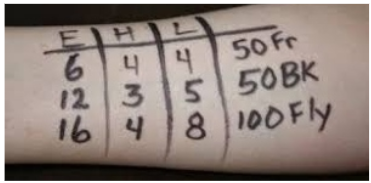
- Use a permanent marker to write the EVENT, HEAT, & LANE information in a grid format on their forearm or thigh, following the details on the meet's heat sheet
- For each event, write the event # (E), heat # (H), and lane # (L).
- For relays, add the relay leg number and stroke information.
|
| What should I eat before a meet? |
- https://www.traindaly.com/train-daly/blog/what-to-eat-before-a-swim-meet-the-best-pre-race-foods
- The night before:
- whole grains or starchy vegetables – complex carbs for sustained energy
- grilled, baked, or broiled chicken or fish – lean easily digested proteins to support recovery, and preserve muscle
- roasted or steamed vegetables – vitamins, minerals, fiber, and water
- fruit – fast-acting carbohydrates, vitamins, fiber, and hydration
- healthy fats:avocados, nuts, olives, olive oil, and nut butters – inflammation fighting health fats that support brain and joint health and fat soluble vitamin absorption
- 2-4 hours before a swim meet – eat a meal high in complex carbohydrates and some protein, like oatmeal with banana, turkey sandwich, pita with hummus, cheese
- 30-60 minutes before – Have a smaller, easily digestible snack (banana, fruit, energy bar)
- Between events – stick to simple, easily digestible carbs for quick energy: banana, small handfuls of raisins or dried fruit, apple sauce, or energy chews/bars.
- Avoid high-fiber, high-fat, or high-protein foods right before events as they take longer to digest and can cause stomach upset. Avoid soda and overly sugary drinks that can cause energy crashes.
|
| How do I know when to line up? |
- It will be crowded (150+ swimmers) and LOUD! Sometimes it is difficult to hear the speaker so pay attention to which event is on.
- Show up to your event early – if you miss your event, please let a timer or coach or board member know and we will try to put you in another lane. Note: HS swimmers at Regionals/State will be disqualified for the ENTIRE meet if they miss an event
- Please line up behind your block the race before yours so you don’t accidentally miss your race. If you’re not sure you’re in the right spot, you can check with the timer at the lane.
|
| Starts |
- Short series of whistles – get ready at the starting end
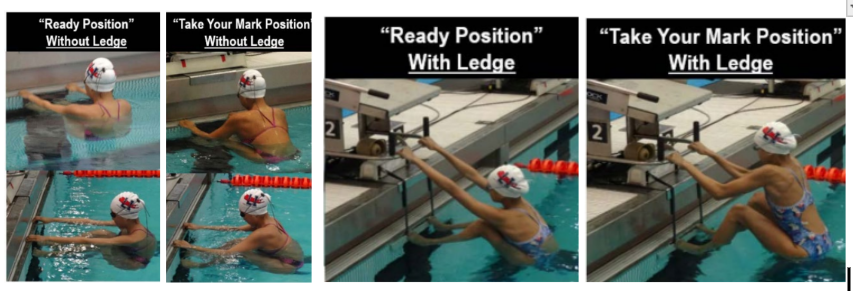
- Long whistle – take your position on the starting platform, the deck, or in the water (if you’re doing backstroke or the IM relay)
- Referee with an outstretched arm – the swimmers and officials are ready
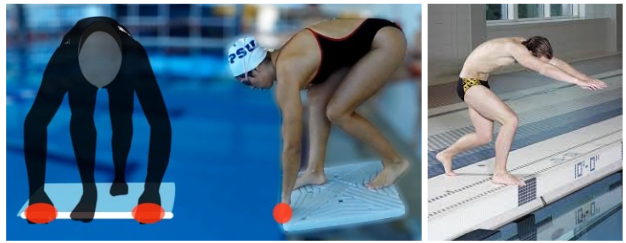
- “Take your marks” – the swimmer assumes their starting position, in the forward start, with at least one foot at the front of the starting platform or the deck. Swimmers starting in the water (backstroke) must have at least one hand in contact with the wall or starting platform.
- Horn/starting signal – swim!!
- “Stand” – swimmers may stand up or step off the blocks (happens when a swimmer does not respond promptly to the command "take your marks”
|
| Forward start (starting position; see pic) |
- At least one foot at the front of the starting platform or the deck.
|
| Backstroke & IM RELAY starting position |
 |
| Relays |
- Medley Relay — backstroke, breaststroke, butterfly, then freestyle
- The next swimmer starts when the teammate touches the wall (swimmers are allowed to start their diving motion before the touch, as long as one foot remains in contact with the starting block)
- Leave the water immediately upon finishing his/her leg, except the last swimmer.
|
| Finishing |
- Relays: swimmers get out as soon as they finish, except the last swimmer stays in lane until all teams have finished the race and the whistle is blown
- Individual events: stay in the lane until everyone has finished and whistle is blown
|
| What happens if my goggles fall off? |
- It happens. No need to stop to put them back on. Keep swimming!
- Ensure a good fit: Adjust the nose bridge and make sure the goggles create a good seal on your face before the dive.
- Tighten the strap: Secure the strap comfortably, but not so tightly that it is painful or causes a poor seal.
- Place straps correctly: Position the straps high on the back of the head, above your ears, to keep the goggles from sliding down.
- Use a cap: Place your goggles on your face first, then put your swim cap on over the goggles to hold the straps firmly in place.
- For extra security, especially in races, wear a cap, then your goggles, then a second cap over the goggles and straps
- Tuck your chin: Keep your chin tucked to your chest when you dive to create a clean entry and avoid the force of the water pulling your goggles down.
- Enter with fingertips first: Your fingertips should enter the water first, followed by your arms and the top of your head, maintaining the tucked chin position.
- Keep goggles pressed: A good seal can be maintained by pressing the goggles into your face before you dive.
|
| Where can I learn more about swimmer rules? |
- Your coach is your best resource!
- Ask your coaches to watch and see if you’re performing the strokes/turns/etc correctly
- Learn from YouTube videos and Instagram swimmers/coaches
- Watch older, more experienced swimmers
- Ask questions!
- USA SWIMMING Rulebook
|
How can I become a better swimmer? |
- Do the Dryland workouts to build strength and endurance
- To become a faster swimmer, focus on minimizing drag, optimizing body alignment, and maximizing propulsion. True speed comes from efficiency rather than just raw effort.
- 11 tips on improving swimming speed: https://www.swimnow.co.uk/stroke-improvement/how-to-improve-swimming-speed/
- How to swim faster without getting tired: https://vasatrainer.com/blog/how-to-swim-faster-without-getting-tired/
- 3 ways to swim faster: https://www.usms.org/fitness-and-training/articles-and-videos/articles/the-three-ways-to-swim-faster
- Focus/mental strategies:
-
Vivid Visualization: Mentally rehearse your race or set before getting in, picturing the exact stroke timing, flip turns, and finish line to prime your nervous system.
-
Focus on Feel, Not Pace: Concentrate strictly on the physical sensation of water pressure on your hands and your rotation, as overthinking splits or competitors creates physical tension that acts like a brake pedal.
-
Hunt and Release Tension: Systematically scan your body for wasted tension (such as a clenched jaw, stiff hands, or tight shoulders) and consciously soften those areas to maintain efficiency.
-
Tunnel Vision on Your Lane: Block out external distractions and competitors on the block by imagining physical barriers around your lane, allowing you to execute your own race plan under pressure.
|